
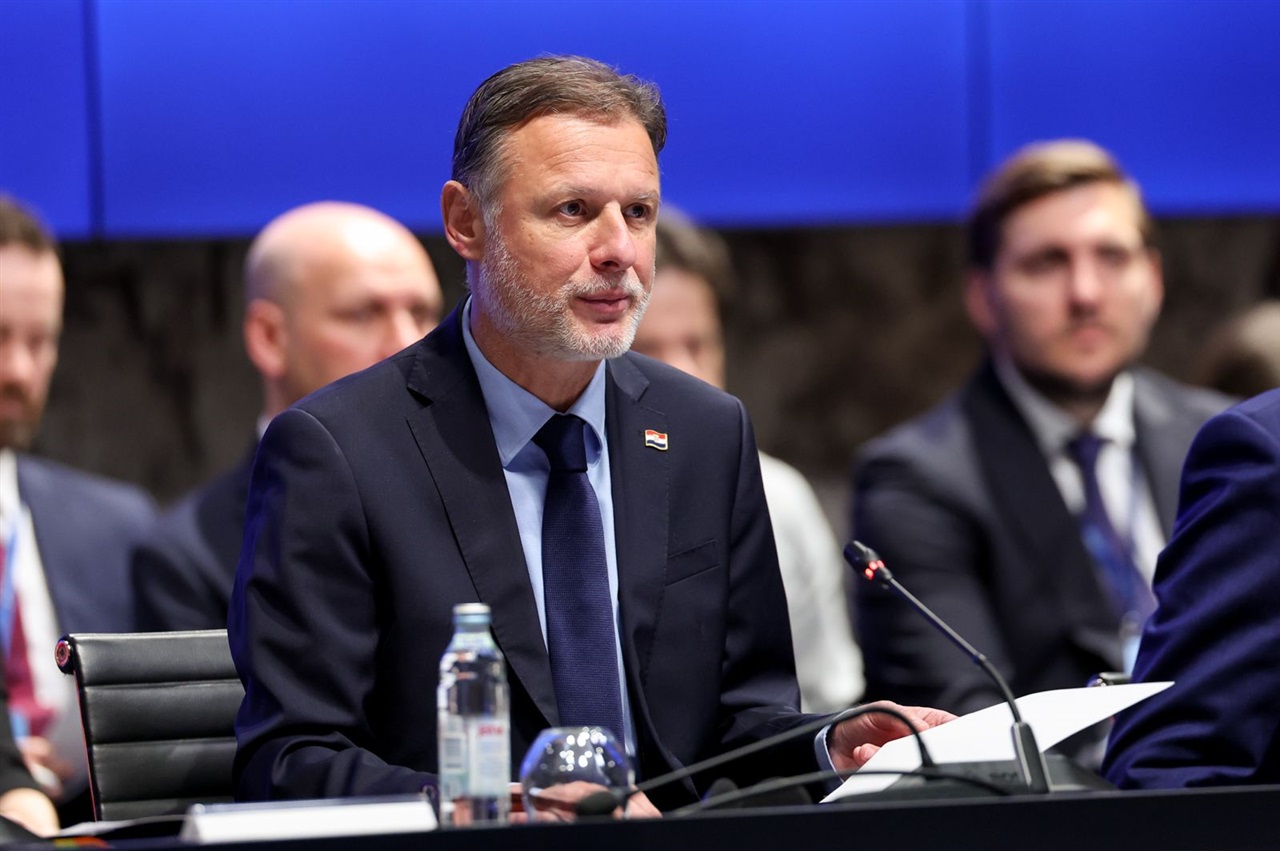
Zagreb - The Speaker of the Croatian Parliament, Gordan Jandroković, opened the Parliamentary Summit of the Three Seas Initiative today, emphasizing the importance of strengthening the Initiative's parliamentary dimension after a four-year hiatus.
Launched in 2015, the Three Seas Initiative today brings together 13 participating states, four associated participating states, and six strategic partners. It is an important political and economic platform aimed at strengthening cooperation in the fields of transport, energy, and digital infrastructure.
The Speaker of the Croatian Parliament emphasized that during the first decade of the Initiative's activity, the decision of participating states to act together in this format has proven correct, especially regarding the need to strengthen strategic connectivity and security.
'The Three Seas Initiative region is becoming Europe's new strategic centre,' he pointed out, noting that the Initiative's member states now comprise nearly a third of the European Union's territory and more than a quarter of its population, while also being the fastest-growing part of the Union.
In the context of an increasingly complex international environment marked by armed conflicts, geopolitical tensions, and fragmentation, alongside rising challenges to multilateralism and international law, Speaker Jandroković reminded of the importance of strengthening resilience of states, particularly through the development of adequate infrastructure and a secure, diversified energy supply.
'Conflicts today do not simply stay where they begin – they cross borders, and travel through energy routes, markets, and supply chains, affecting other battlefields as well,' he said, reminding of Russia's increasing oil trade revenues due to the war in Iran, as well as the stalemate in peace negotiations in Ukraine.
Speaker Jandroković reaffirmed Croatia's strong support for Ukraine in its struggle for freedom and territorial integrity. 'Croatia remains as resolute as we have been from the very beginning. Just like wide support was demonstrated in this very hall, in October 2022, when we co-organized, with Verkhovna Rada, the First Parliamentary Summit of the International Crimea Platform, with around 50 chambers of parliaments participating', Jandroković said.
Speaking on the specific role of the Three Seas Initiative, he emphasized that it represents a concrete strategic instrument for strengthening resilience and security through the development of transport corridors, ports, highways, railways, energy routes, and digital networks. He noted that these elements shape the economic power, connectivity, and geopolitical influence of the region.
In this context, he highlighted Croatia's role as a vital transport and energy hub.
'The fact is that we are really a highly convenient Adriatic entry point for Central and Southeast Europe,' he emphasized, pointing to projects such as the LNG Terminal on the island of Krk, the Adriatic Pipeline (JANAF), and the expansion of the Port of Rijeka. Croatia has positioned itself as a relevant and reliable partner contributing to the overall connectivity of the wider region. He also recalled the high level of development of the Croatian motorway network and announced significant investments in railway infrastructure.
Jandroković added that national efforts are not necessarily sufficient on their own. It is precisely the Three Seas Initiative that provides the framework for aligning priorities and creating a broader impact.
He mentioned projects that are clearly changing the European infrastructural landscape for the better, from the Baltic through the Black Sea region to the Adriatic. Among them are projects with clear dual-use potential; therefore, it is essential to always strengthen the capacities for protecting critical infrastructure.
He stressed the importance of project financing, including national and EU funds, funds established within the Initiative, and the mobilisation of private capital. 'Otherwise, even the most carefully planned endeavours remain only plans,' Jandroković said.
Jandroković placed special emphasis on the role of parliaments in ensuring the long-term sustainability of projects through appropriate legislative frameworks, budget adoption, debate that connects long-term strategy with public understanding, ensuring continuity, beyond political cycles.
'What guided Croatian Parliament in organizing this Summit is recognizing added value of parliamentary cooperation within the Three Seas,' Jandroković said, continuing that 'without adequate parliamentary involvement, even the most ambitious projects risk remaining temporary.'
Furthermore, the Speaker addressed the importance of pursuing smart partnerships. Transatlantic cooperation needs to remain at the very core of the Three Seas, particularly in energy and advanced technologies. He also highlighted connections with other global initiatives, such as the India-Middle East-Europe Economic Corridor (IMEC) and the Trans-Caspian International Transport Corridor, which offer opportunities for a new positioning of the Three Seas region within broader global networks. In that context, he expressed satisfaction with the participation of strategic partners from Türkiye, as well as special guests from Azerbaijan and Egypt.
Regarding European policies, the Speaker emphasized the Initiative's complementarity with the EU enlargement process, highlighting its contribution to the stability and prosperity across the wider European space.
In conclusion, Speaker Jandroković pointed out that citizens rightly expect concrete results – lower energy prices, better transport connectivity, new economic opportunities, and a better standard of living. 'Our citizens may not follow every detail of infrastructure corridors or new laws. But they do understand outcomes: energy prices, transport efficiency, economic opportunities,' Jandroković said, adding, 'Ultimately, we will not be judged by our strategies, but by results.'
Calling on the parliaments of participating states to take an active and responsible role in the Initiative's work, Speaker Jandroković expressed confidence that the summit discussions would contribute to its further development. He noted his expectation that the April Summit of Heads of State and Government and the accompanying Business Forum in Dubrovnik would yield significant concrete results.