
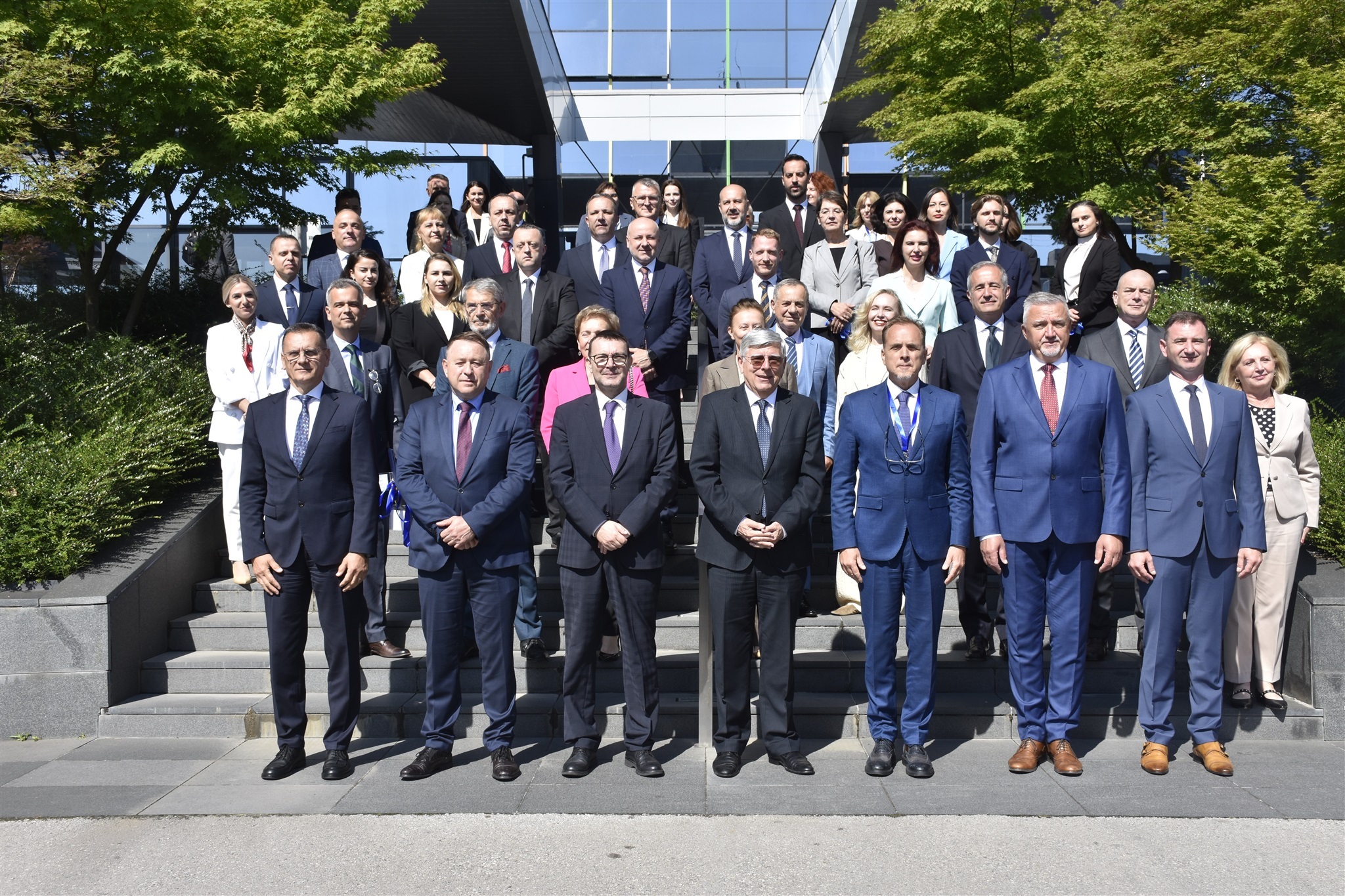
Zagreb – The Annual Meeting of Representatives of Defence and Security Committees from South East Europe Parliaments was held on 2 and 3 June 2026, jointly organized by the Defence Committee of the Croatian Parliament and the RACVIAC – Centre for Security Cooperation, in cooperation with DCAF – Geneva Centre for Security Sector Governance, the OSCE Office for Democratic Institutions and Human Rights (OSCE ODIHR), and the OSCE Mission to Bosnia and Herzegovina.
The meeting brought together more than 40 participants from Albania, Bosnia and Herzegovina, Croatia, Greece, Montenegro, North Macedonia, and Türkiye, providing a valuable platform for the exchange of experiences and good practices in parliamentary oversight of the defence and security sector. Discussions focused on parliamentary procedures, current security challenges, and oversight mechanisms, with particular emphasis on the OSCE Code of Conduct on Politico-Military Aspects of Security as a normative framework for democratic control and parliamentary oversight of defence and security institutions in today’s evolving security environment.
Held over two days, the Meeting featured three interactive working sessions and fostered open dialogue among parliamentarians, experts, and practitioners from across South East Europe.
In their opening remarks, the speakers emphasized the growing importance of parliamentary oversight, regional cooperation, and democratic governance in addressing today’s complex security challenges. Ambassador Miroslav Šćepanović, Director of RACVIAC highlighted RACVIAC’s role as a platform for regional dialogue and security cooperation in South East Europe, underlining its long-standing partnership with the Croatian Parliament, DCAF, the OSCE ODIHR, and the OSCE Mission to Bosnia and Herzegovina. Mr. Arsen Bauk, Chair of the Croatian Parliament’s Defence Committee, stressed that the Annual Meeting provides an important opportunity for the exchange of experiences and good practices in parliamentary oversight, contributing to stronger interparliamentary cooperation and regional stability. Mr. Ante Deur, Deputy Chair of the Defence Committee and member of the Domestic Policy and National Security Committee, reaffirmed Croatia’s support for RACVIAC and emphasized the importance of confidence-building and cooperation in responding to contemporary security challenges.
State Secretary at the Ministry of Defence of the Republic of Croatia, Mr. Drago Matanović, highlighted the need for increased defence investment and stronger societal resilience, while underlining the key role of parliamentary committees in ensuring effective democratic oversight of the armed forces and security institutions. Dr. Teodora Fuior, Senior Manager at the Europe and Asia Division of the Geneva Centre for Security Sector Governance (DCAF), noted that rising defence spending across Europe reinforces the need for transparency, accountability, and effective parliamentary scrutiny, while Dr. Yulia Netesova, Chief of the Democratic Governance and Gender Unit at the OSCE ODIHR, emphasized that democratic oversight is essential to ensuring that security institutions exercise their powers in accordance with the rule of law and human rights commitments.
The keynote address at the opening session of the meeting, delivered on behalf of the Speaker of the Croatian Parliament, was given by Deputy Speaker of the Croatian Parliament, Academician Željko Reiner. Reiner reflected on the rapidly changing international security environment and stressed the importance of multilateral cooperation, dialogue, and partnerships in promoting peace, stability, and security.
During the first session called “Parliamentary Oversight of the Defence and Security Sector – current situation and good practices”, participants discussed the current state of parliamentary oversight of the defence and security sector and exchanged good practices from across the OSCE region. Speakers highlighted the importance of effective parliamentary oversight in safeguarding democratic accountability, transparency, the rule of law, and public trust, particularly in light of evolving security challenges, increasing defence expenditures, and expanding security powers. The discussion focused on the role of parliamentary committees in overseeing emerging security issues such as cyber threats, disinformation, artificial intelligence, and societal resilience. Participants also emphasized the importance of strong committee structures, access to information, institutional capacity, and meaningful involvement of opposition members in oversight processes.
The second session, titled “Protection of Rights and Responsibilities of the Members of the Armed Forces and Police in South East Europe”, focused on the protection of human rights, working conditions, and professional integrity of members of the armed and security forces, as well as the role of independent oversight mechanisms in safeguarding those rights. The session concluded by reaffirming the value of independent oversight mechanisms in strengthening accountability, improving institutional performance, and ensuring that members of the armed forces and police are treated as citizens in uniform whose rights must be effectively protected.
The first day concluded with a visit to city of Varaždin, where participants were welcomed by the Mayor and deputy mayor of Varaždin, Dr. Neven Bosilj and Mr. Miroslav Marković at official reception, allowing for informal exchange and further dialogue among colleagues.
The second day of the meeting continued with the third working session, titled “OSCE Code of Conduct as a Normative Framework of Parliamentary Oversight over Defence and Security in the Current Environment for the Rules-Based International Order”. The session focused on the OSCE Code of Conduct as a foundational normative instrument for democratic control of armed forces and parliamentary oversight in the OSCE area. The discussion further explored the evolution of the Code’s principles within the broader OSCE security sector governance framework and reflected on a 30 years of implementation experience across participating States. In the second part of the session, parliamentary representatives shared national experiences on the implementation of the Code, including parliamentary oversight practices, reporting mechanisms, and key challenges and good practices. The session concluded with a moderated discussion emphasizing that the OSCE Code of Conduct remains a central normative anchor for democratic oversight of the security sector, while parliamentary engagement is essential for its effective implementation and for strengthening trust, legitimacy, and accountability within security institutions.
During closing session remarks were delivered by Mr. Ante Deur, Mr. Arsen Bauk, and Ambassador Miroslav Šćepanović, highlighting the value of continued dialogue, regional cooperation, and parliamentary engagement in strengthening democratic oversight in the defence and security sector.