
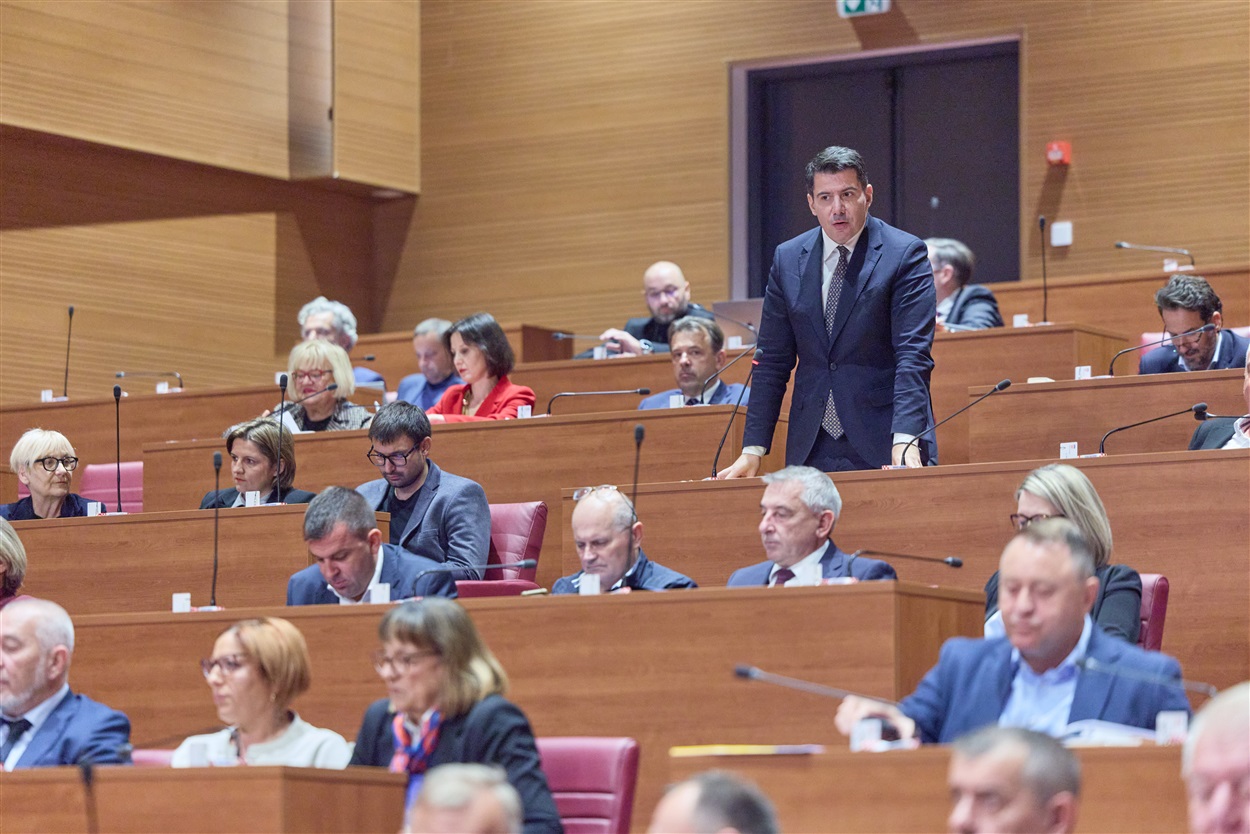
Zagreb - The Sabor concluded debate late on Tuesday on the proposed 2027 state budget and projections for 2028 and 2029, with opposition MPs warning about rising spending and inflation, while ruling coalition highlighted social security for all generations and measures benefiting young people.
"Every day, we will spend €11.5 million more than we earn. How are we going to make up the difference?" Damir Barbir of the Centre party asked during the debate.
Barbir said the state budget should not be treated like a household budget and that the government could run a deficit, provided it invested in the future.
"We need to ask ourselves which expenditures create added value and which merely sustain an expensive and bloated political apparatus funded by taxpayers," he said.
SDP MP Sanja Radolović said that, despite the economic growth highlighted by the government, Croatia was still experiencing a sharp rise in inflation, particularly in areas with the greatest impact on household budgets: food, utility bills and energy costs. She also criticised the lack of a comprehensive national energy strategy.
Regarding criticism from the Opposition over dwindling EU funds, HDZ MP Josip Borić countered that the government was fighting for every billion euros under the EU's multiannual financial framework for 2028-2034.
“Of the €41 billion in total budget expenditure, €22 billion goes towards social sustainability, supporting every Croatian citizen who needs a transfer from the state budget during the year,” he said.
Addressing the position of young people, Borić said youth unemployment had halved, the number of people on permanent contracts had increased by 85,000 over the past decade, and more than 5,000 young families had received tax refunds when purchasing their first home.
For the Homeland Movement (DP), three issues are paramount: the demographic survival of the Croatian people, the country's economic and energy security, and the preservation of domestic agricultural production, MP Tomislav Josić said.
We Can! MP Rada Borić highlighted the importance of supporting kindergartens and building and equipping primary schools to enable all-day schooling.
"Investing in kindergartens and schools means investing in greater gender equality. More accessible childcare and all-day schools are essential prerequisites for mothers' full participation in the workforce," she said.
The Istrian Democratic Assembly (IDS) has submitted 32 amendments to the proposed budget, worth just over €112 million in total.
IDS MP Anteo Milos said pension tax relief and the recent public sector pay agreement had a direct impact on the sustainability of municipal and city budgets.
He called on the government to draw up and present to parliament, within a year, a model under which municipalities and cities would receive a share of existing VAT revenue, taking into account where the spending actually takes place.
Minorities' MPs welcome continued investment in projects benefiting their communities
MP Anja Šimpraga of the Independent Democratic Serb Party (SDSS) welcomed the continuation of investment in infrastructure, social policy, demographic revitalisation and regional development in next year's budget. However, she warned that basic communal infrastructure remained a challenge and that small municipalities often lacked the resources to provide residents with adequate living conditions.
Marin Corva, representing the Italian minority, said the proposed budget demonstrated tangible progress in protecting the rights of all minorities.
"The issues I have raised, including school extensions, stronger Italian-language radio programming and the position of teachers, are not demands directed against anyone. They are an invitation to continue working together, in the spirit of cooperation we have built with the government, towards a Croatia in which diversity is an asset," Corva said.