
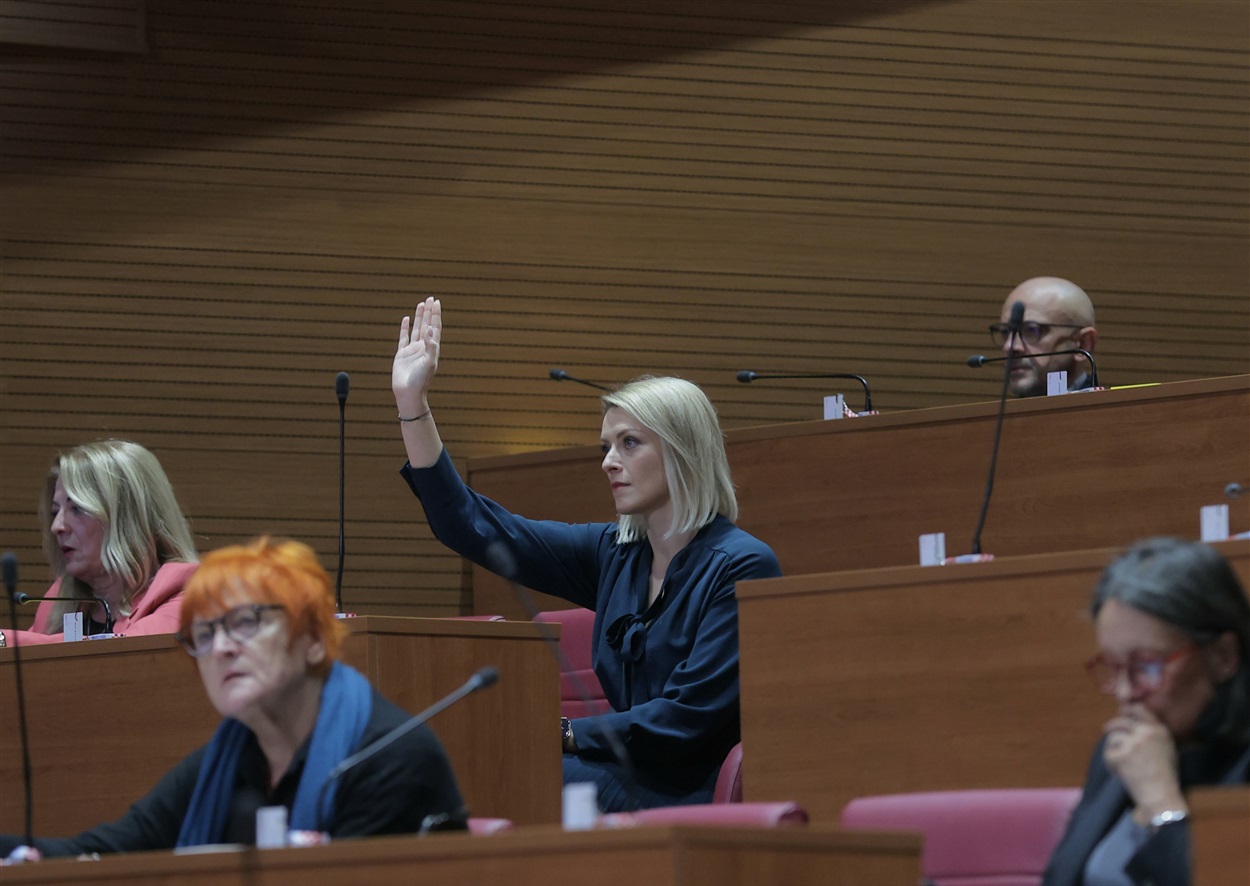
Zagreb - The draft amendments to Croatia’s Waste Management Act drew opposition criticism in parliament on Wednesday, with the opposition arguing that the problem was not a lack of legislation but its failure to be enforced.
The ruling parties said the amendments would make the waste management system more effective.
"We call on the prime minister to resign and call snap elections over everything that has happened in Croatia, including the poisoning of people, soil and groundwater. Let him show a grain of honour and morality and let the people decide what happens next," Bridge MP Marin Miletić said.
Nino Raspudić (Drito) said the problem was not the law itself, but that it had been breached and that the relevant authorities had failed to do their job, which he described as "a huge political responsibility".
Krešimir Čabaj (Home and National Rally - DOMINO) likewise said the problem lay not in a lack of legislation but in the system itself.
"There are some good things in this law, but they do not address the root of the problem. We could even introduce a VAR room into the waste management system, but the people sitting in that room are what matters for the system to work," he said.
SDP: Amendments not reform but belated admission that system failed
SDP MP Mihael Zmajlović said the proposed amendments "are not reform, but a belated admission that the system failed".
"Yesterday we learned that 44,000 tonnes of waste are involved, with €40 million needed just for the buried waste. That is the cost not only of crime but also of institutional inaction," he said, warning that criminal profits must not remain private while clean-up costs are borne collectively.
“Gospić is not an isolated failure; it is a systemic problem. Gospić is the responsibility of this government and (Prime Minister Andrej) Plenković, and no legislative amendments can erase that responsibility," he said.
IDS MP Dalibor Paus and Dušica Radojčić (We Can!) said the government was still pursuing a plan to incinerate some of the waste from Gospić in Koromačno, despite a decision by the Istrian County Assembly calling on the government to abandon the plan.
Anja Šimpraga (SDSS) said the law must not become a list of new obligations, but an instrument demonstrating that the state can enforce its own rules.
She said key priorities were monitoring illegal practices, penalising those responsible, recovering costs and ensuring a swift state response when problems are detected.
HDZ: Law's preparation since 2024 shows sensitivity of issue
Damir Mandić (HDZ), meanwhile, said the amendments largely define what needs to be added and done to bring waste management under control and enable its implementation to be monitored.
"The fact that the law has been in preparation since 2024 shows how sensitive this issue is. It is also an opportunity to bring it closer to our citizens and make decisions that will benefit both our people and the environment," he said.
Ivica Kukavica (Homeland Movement) said waste management should not be turned into a purely political issue, arguing that the problem was not specific to the current government or ruling majority. He called for the introduction of a ranger service.
Darko Klasić (HSLS) said the cases of Gospić, Poznanovec, Dioki, Black Hill, Varaždin and Jakuševec were the result of “shameless political populism and irresponsibility by all political actors to date”, as well as the public’s assumption that someone else would deal with the waste problem.
He added that attempts to address the waste issue through waste-to-energy plants were often thwarted.