
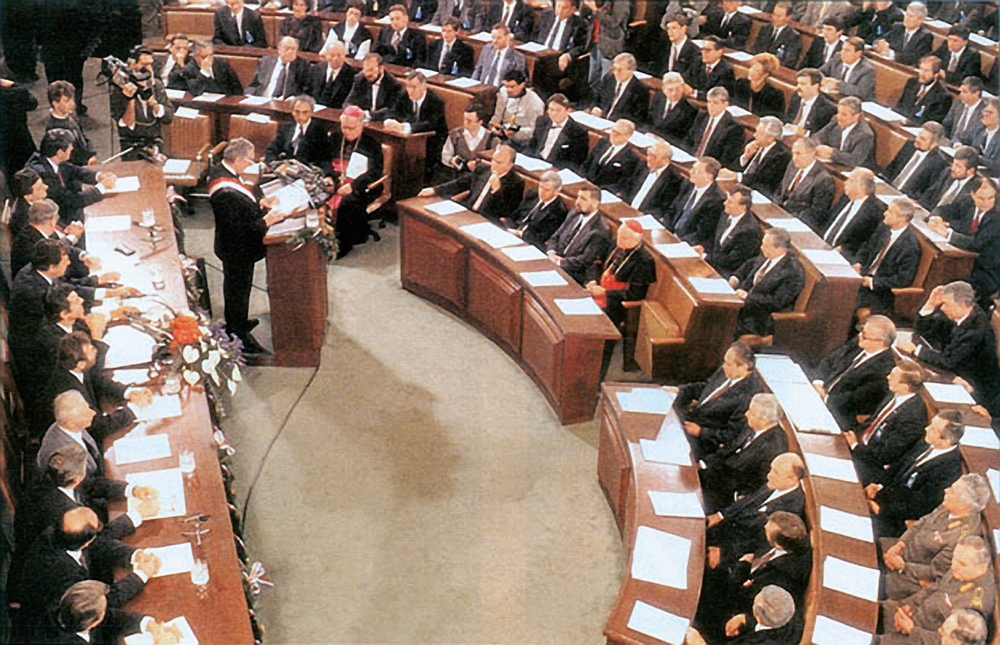
Zagreb - Thirty-five years ago, on 21 December 1990, the first Croatian Parliament adopted the first Constitution of the Republic of Croatia, which paved the way for its independence and sovereignty, and this charter, adopted a few days before Christmas, is also known as the Christmas Constitution.
"Definitely, the adoption of the Constitution has the characteristics of an exceptional historical act, and this for two reasons," said Croatia’s first president, Dr Franjo Tuđman, at the proclamation of the Constitution a day later. Earlier that summer, he had presented the guidelines for drafting the new Constitution.
Tuđman stressed that the Constitution marked a final break with the communist rule which was the socialist self-management one-party system and represented the "cornerstone" in building full national state sovereignty.
"The final judgement on the true significance of today’s act will undoubtedly be passed only by future generations, in the context of further historical developments," Tuđman said at the ceremony of the promulgation the Constitution on 22 December.
The day before, the Sabor had adopted the document at a joint session of all three of its councils – the Council of Municipalities, the Council of Associated Labour and the Socio-Political Council.
Krstulović Opara: I knew I was taking part in a historic event
"All that was very impressive, the bells of St Mark’s Church were ringing,” recalls Andro Krstulović Opara (HDZ), now an MP, who was the youngest member of the first Sabor. At the time he was a 24-year-old student.
He arrived at the ceremonial session from the "Cvjetno naselje" student dormitory, says he did not own a formal suit, and borrowed a tie from a colleague.
At the time, MPs performed their duties on a voluntary basis and received an allowance that would today be worth around 70 euros, Krstulović Opara notes.
He says he was "very much" aware that day that he was taking part in a historic event he would remember for the rest of his life.
“President Tuđman knew how to inspire people with his speeches; for days he gave us the feeling that we were doing something important," he said, adding that MPs viewed the adoption of the Christmas Constitution as a process in the creation of Croatia, not as an isolated event.
1990 - pivotal year
With the promulgation of the Constitution, Croatia, then still part of the Socialist Federal Republic of Yugoslavia, concluded an exceptionally dynamic and pivotal year, 1990.
In the spring, the first multi-party democratic elections were held; on 30 May a new democratic government led by the HDZ (the Croatian Democratic Union) was established; and in mid-August an armed rebellion by part of the local Serb population broke out, known as the "log revolution", because rebels used logs to put up barricades on roads in the areas where ethnic Serb communities live, such as a wider area of Knin.
Work on the new Constitution also began in the summer of that year. It was operationally led by the Parliamentary Commission for Constitutional Affairs and the Constitutional Commission of the Presidency of the Republic, following the guidelines set out by President Tuđman.
These guidelines included the principles of multi-party parliamentarianism, Croatia’s economic and political effectiveness, its sovereignty, and respect for human and civil rights.
A total of 229 members of different political orientations, ages and professions were appointed to the Constitutional Commission.
"Their direct contribution to the final wording of the Constitution may be small in volume, but it is great in importance," Tuđman said at the ceremonial session.
Draft Constitution written in Malinska on island of Krk
The draft of the first Croatian Constitution was written over two weeks in August in Malinska on the island of Krk, which is why it became known as the "Krk Constitution". Almost three quarters of that draft ultimately made it into the Christmas Constitution.
The draft was prepared by a working group consisting of Vladimir Šeks, Smiljko Sokol, Krunislav Olujić and Ljubomir Valković. As Sokol explained in Tomislav Galović’s book The Croatian Constitution and its Krk Draft (1990), the choice of Malinska was made for fairly prosaic reasons.
The location was close and easily accessible for everyone; at the time one of Croatia’s most beautiful hotels was still operating there; and also because his holiday home was in the nearby village of Sveti Vid.
The draft of the new Constitution was published in Vjesnik on 27 November and attracted great public interest. By 20 December 1990, the Commission for Constitutional Affairs had received around a thousand pages of comments and proposals – three volumes in total.
Proposals were submitted by citizens, local communities, municipal assemblies, religious communities, political parties, professional and other associations, and many others, reported Šeks, president of the parliamentary Commission for Constitutional Affairs, which had been tasked with preparing all constitutional and legal documents for the adoption of the new Constitution.
It was a time without the internet and email; materials were delivered to MPs in physical form. Given the large number of comments on the draft Constitution, it was technically impossible to distribute them all at once.
The Commission therefore decided to distribute them gradually, in three volumes. The first two contained around 600 pages of text each.
MPs received the first by post, while the second was distributed on the parliamentary benches on 21 December and included comments received up to 18 December.
From the Constitutional Commission of more than two hundred members emerged a second, more operational expert working group consisting of Veljko Mratović, Smiljko Sokol, Nikola Filipović, Branko Smerdel and secretary Darko Bekić.
The final text of the proposed Constitution was prepared by the "Editorial Task Force" made up of Šeks, Sokol and Zdravko Tomac. The foundational principles, or preamble, were written by Franjo Tuđman.
Nine sections with 142 articles
The new Constitution consisted of nine sections with 142 articles and was among the shorter European constitutions.
It defined the Republic of Croatia as the national state of the Croatian people and a state of members of autochthonous ethnic minorities, as a unitary and indivisible democratic and social state.
It provided for a system of representative democracy and the principle of the separation of powers.
"With this Constitution, the Croatian people will confirm their centuries-old statehood at today’s historic turning point. Having rejected the half-century unnatural communist system, we shall continue to build a modern, sovereign and law-based Croatian state," said the first Speaker of Parliament, Žarko Domljan.
However, defining Croatia as the national state of the Croatian people was not well received by some MPs of Serb descent who had been elected to Parliament from various party lists. Thus Marko Atlagić (SS-SSH) stated that the adoption of such a Constitution, "which places the Serb people in the status of a national minority, also means a declaration of civil war by the Serb people in Croatia". Dušan Ergarac (SDS) meanwhile "warned" the Sabor that if "such a Constitution" were adopted, it "would not be applied on the territory of Krajina, where the Serb people live".
Enthusiastic reception by general public
Everything that took place in Parliament and in St Mark’s Square in 1990 was closely followed by the Croatian general public, and ordinary citizens often gathered beneath the parliamentary windows.
The same was true of the Christmas Constitution, whose promulgation was celebrated at Zagreb’s City Café, in front of which a large crowd of citizens also gathered. Carried away by their enthusiasm, Domljan exclaimed, "We’ve got it!", referring, of course, to the Constitution.
Time has taken its toll: many of those involved in the adoption of the first Croatian Constitution and participants in the historic session of December 1990 are no longer alive. The memory of them and of 22 December has been preserved in the painting "The passing of the first Croatian democratic constitution on December 22, 1990" by artist Jadranka Fatur.