
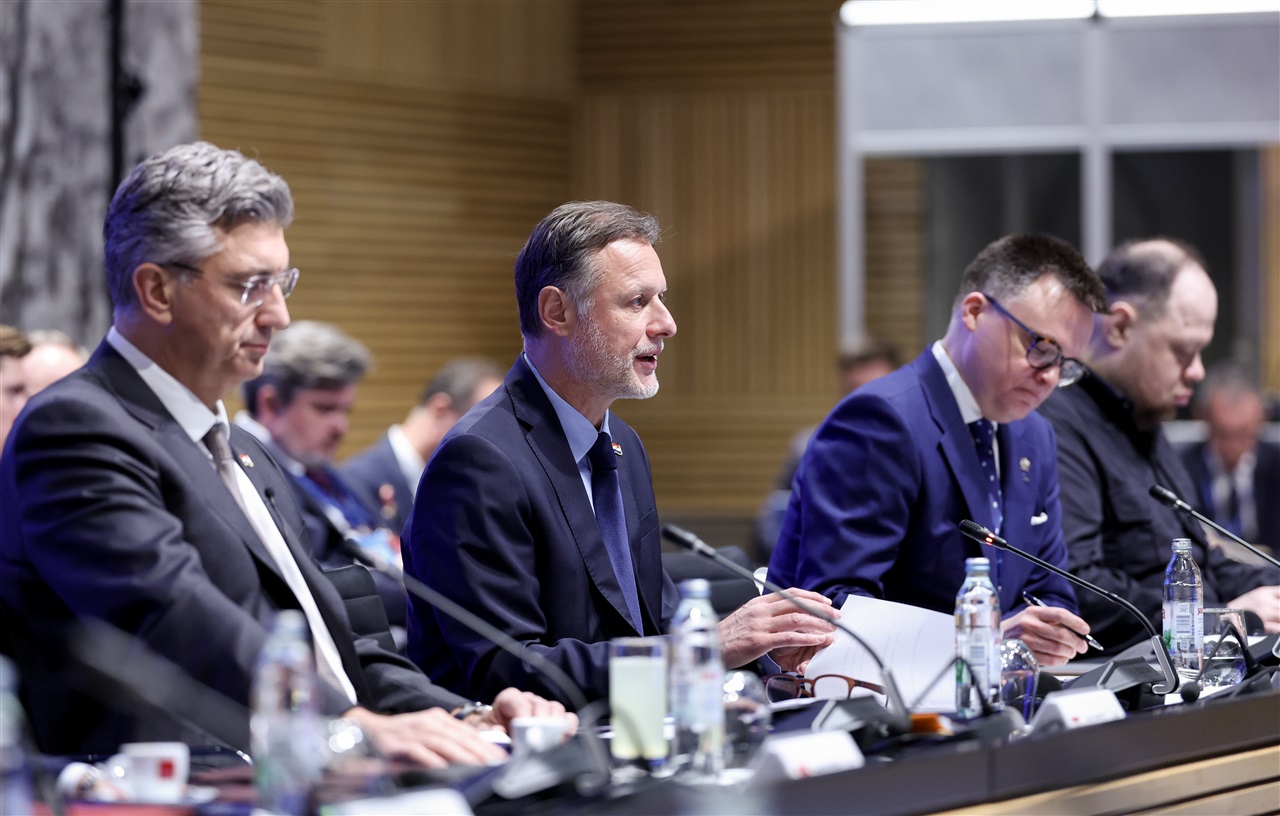
Zagreb – The Parliamentary Summit of the Three Seas Initiative highlighted the Initiative’s increasingly important role as a strategic framework for strengthening Europe’s connectivity, security, and resilience, with an emphasis on expanding cooperation into the broader Euro-Mediterranean area.
Participants assessed that, ten years after its establishment, the Initiative is entering a new phase of development in which infrastructure connectivity is increasingly complemented by security, political, and geostrategic dimensions, particularly in the context of current global challenges and Russia’s aggression against Ukraine.
Prime Minister Andrej Plenković emphasized that the Three Seas Initiative is evolving beyond its original infrastructure-focused purpose and is becoming an important instrument for strengthening Europe’s resilience in changing geopolitical circumstances. He underlined the role of transport, energy, and digital corridors as the foundation of the European Union’s strategic autonomy, noting that Croatia contributes to strengthening regional energy security through the LNG terminal on the island of Krk and the Adriatic Pipeline (JANAF).
In the opening part of the summit, Vice-Marshal of the Polish Sejm Szymon Hołownia stressed the need to strengthen the Initiative’s strategic vision and political coordination, emphasizing that the changing geopolitical environment requires more intensive cooperation between governments and parliaments, as well as deeper integration in the areas of energy, defence, infrastructure, and foreign policy.
European Commissioner for the Mediterranean Dubravka Šuica highlighted the importance of strengthening regional cooperation and connectivity in the broader European and Mediterranean context, underlining the role of the Union for the Mediterranean as a key platform for political dialogue, economic cooperation, and stability. She particularly emphasized the need to develop transport, energy, and digital projects linking the European Union with its southern neighbourhood, alongside mobilising investment and strengthening partnerships.
Special emphasis was placed on the security dimension and Europe’s resilience. Speaker of the Verkhovna Rada of Ukraine, Ruslan Stefanchuk, stressed that the area between the Baltic, Adriatic, and Black Seas represents the “backbone of a new free Europe,” highlighting Ukraine’s contribution to European security despite wartime conditions. He warned of the scale of Russian aggression and attacks on civilian infrastructure, emphasizing the need for joint action by democratic states and strengthening institutional resilience.
Speaker of the Grand National Assembly of Türkiye, Numan Kurtulmuş, warned of shifts in the international order and growing security challenges, highlighting the importance of more effective international cooperation and stronger multilateral mechanisms.
The plenary session brought together speakers of parliaments from participating states, associated participating states, and strategic partners of the Three Seas Initiative, along with special guests of the Summit, who emphasized the importance of further developing transport, energy, and digital corridors, as well as strengthening mutual connectivity as the foundation of Europe’s competitiveness and resilience.
Speaker of the Seimas of Lithuania, Juozas Olekas, President of the Senate of Romania, Mircea Abrudean, and Speaker of the National Council of the Slovak Republic, Richard Raši, highlighted the importance of energy security, interconnections, and infrastructure investment, while President of the National Council of Slovenia, Marko Lotrič, emphasized the role of parliamentary institutions in strengthening resilience and digital transformation.
Speaker of the Parliament of Albania, Niko Peleshi, emphasized the importance of including Western Balkan countries in European infrastructure and development flows, as well as their contribution to regional stability.
President of the Parliamentary Assembly of the Union for the Mediterranean, Mohamed Abou El Enein, also highlighted the significance of the Mediterranean dimension, underlining the role of the Parliamentary Assembly of the Union for the Mediterranean as a platform for dialogue and cooperation between countries on both shores of the Mediterranean. He particularly stressed the importance of youth inclusion, strengthening partnerships, and developing joint projects aimed at stability, sustainable development, and interregional connectivity.
Vice-President of the European Parliament Victor Negrescu confirmed that the Three Seas Initiative represents an important platform for strengthening regional connectivity and Europe’s capacity to respond to changing geopolitical circumstances, with emphasis on the importance of European Union enlargement and the integration of partner countries.
Vice-President of the National Assembly of Azerbaijan Rafael Huseynov spoke about the importance of energy cooperation and Azerbaijan’s role as a reliable partner in natural gas supply, highlighting the contribution of the Southern Gas Corridor to diversifying energy sources and strengthening Europe’s energy security.
In their statements, summit participants further emphasized that connectivity goes beyond infrastructure, encompassing energy security, digital transformation, and the exchange of knowledge and values, as well as linking Europe with the Mediterranean through concrete projects and initiatives.
It was particularly underlined that current geopolitical challenges, including the war in Ukraine, further confirm the need for coordinated European action, strengthening resilience, and protecting the international legal order.
In the first part of the plenary session, it was concluded that the Three Seas Initiative reaffirms its role as a strategic framework contributing to Europe’s stronger connectivity, security, and resilience, with an increasingly pronounced Euro-Mediterranean dimension and a clear message that cooperation, partnership, and joint action remain essential for stability and development in today’s global circumstances.