
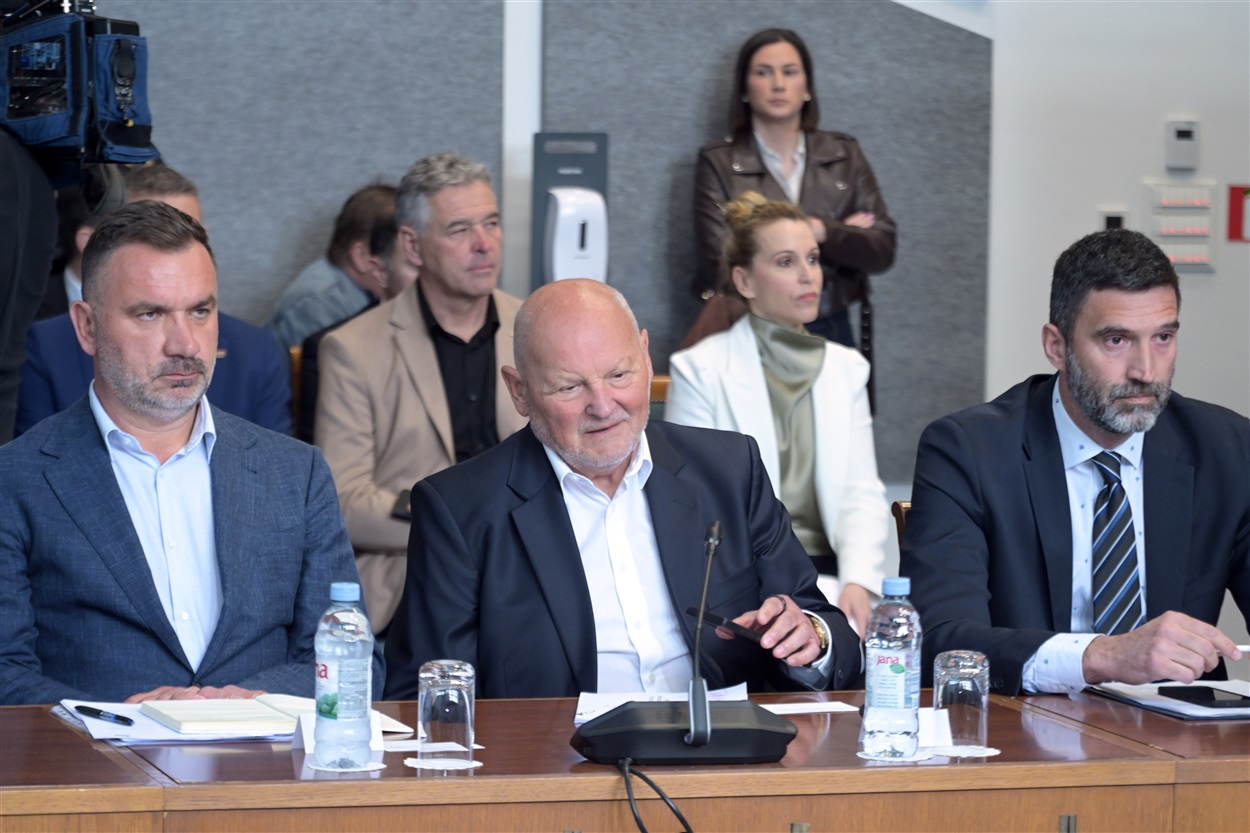
Zagreb - The parliamentary committee on sport on Wednesday ended its session on the non-transparent financing of sports federations without adopting any conclusions, while HOO chair Zlatko Mateša insisted that sports federations are independent legal entities responsible for their own operations.
Opening the session, Committee Chair Vesna Vučemilović said that “the positive things sport brings have been overshadowed by events that are snowballing” following revelations about the alleged syphoning of €30 million from the Croatian Ski Federation, as well as media reports concerning irregularities in the Croatian Judo Federation, the Croatian Chess Federation, the Croatian Volleyball Federation, and investigations involving the Croatian Olympic Committee itself.
“Burying our heads in the sand in this situation is truly unacceptable. This is an opportunity to implement long-term changes that will prevent such situations and cleanse the Croatian sports system of undesirable elements,” Vučemilović said.
She also assessed that the new rulebook proposed by the Ministry of Tourism and Sport is a step in the right direction to ensure that public and sponsorship funds allocated to sport actually reach their intended beneficiaries.
State Secretary at the Ministry of Tourism and Sport Josip Pavić said that the new rulebook is the first in a series of measures aimed at increasing transparency in the allocation and monitoring of public spending. It is currently undergoing a public consultation process that runs until 16 June.
As one of the key innovations of the rulebook, Pavić highlighted that all legal entities within the sports system whose programmes receive co-financing from the Ministry of Tourism and Sport or other public beneficiaries exceeding €50,000 annually or per project will receive payments exclusively through specially designated bank accounts.
Among other measures, he stressed that a financial monitoring register will be introduced for beneficiaries directly funded by the Ministry for the organisation of major sporting events.
“It will become mandatory to submit receipts, invoices and proof of payment at the lowest level at which the programme is approved, immediately after each individual request has been implemented by the umbrella sports organisation when we are speaking about national sports federations,” Pavić said.
He added that information on spending by beneficiary and programme will be continuously available at all times.
Speaking about federation financing, Zlatko Mateša said that national sports federations are independent legal entities responsible for their own documentation and operations, and noted that the Croatian Olympic Committee (HOO) has so far received no objections from external auditors.
He specifically addressed the case of the Croatian Ski Federation and media reports concerning its former president Vedran Pavlek.
“We carried out that inspection and I can say with full responsibility that, as far as the Croatian Ski Federation is concerned, public funds were spent appropriately,” Mateša stated.
Deputy Chair of the Committee and member of The Bridge, Marin Miletić, who initiated the thematic session on insufficient transparency in the funding of federations, pointed to numerous examples of alleged irregularities across several national sports federations and asked Mateša how much money the HOO annually pays to the private clinic of Dragan Primorac for “services that Primorac’s clinic performs for the Committee”, and whether this constituted a conflict of interest given that Primorac is a member of the Croatian Olympic Committee Council.
Mateša responded that he was unaware of the Croatian Olympic Committee specifically financing Primorac’s clinic, adding that the organisation has contracts with a number of public hospitals.
“I will gladly provide that information. If we did use the clinic’s services, that would constitute a conflict of interest, which is precisely why I will check and provide the data as soon as I return,” Mateša said.
Croatia waiting for Pavlek's handover
An Interpol arrest warrant for Pavlek was issued at the end of March over suspicions that he siphoned nearly €30 million from the Ski Association, and his arrest in Kazakhstan was confirmed on 1 May.
Alongside Pavlek, pre-trial detention has been ordered for several others linked to the case, including former HSS secretary general Damir Raos, accountant Božena Meić Hrvoj, Slovak national Martina Strezenicki, and Austrian–Liechtenstein citizen Georg Mauser, who is unavailable to Croatian authorities.
Authorities believe the group of siphoned nearly €30 million from the association, with about one-third allegedly transferred to Pavlek’s foreign bank accounts. The investigation has since expanded to other sports associations, with the Croatian Olympic Committee stating it is cooperating with state bodies and providing requested documentation.
Earlier on Wednesday, Krešimir Devčić, spokesperson for the Zagreb County Court, informed Hina that the former Secretary General of the Croatian Ski Federation, Damir Raos, a co-defendant of the fugitive former federation president Vedran Pavlek, suspected of embezzling around €30 million from the federation, had been released from custody on Tuesday.
Pavlek is suspected of having, in his capacity as director of the Croatian Ski Federation, from 2014 until the end of February 2026, organised a criminal enterprise involving the other six suspects, one man who has since died, and several as yet unidentified individuals who allegedly managed the operations of multiple companies.
According to USKOK (Office for the Suppression of Corruption and Organised Crime), Pavlek established a criminal organisation operating through companies based in Zagreb, Austria, Liechtenstein, Monaco, Spain, Russia, Hungary, Switzerland, Serbia, San Marino, Slovakia and Italy. The prosecution alleges that the former HSS director, acting as the owner of companies in Monaco and Spain, also made connections with a company belonging to the now deceased individual from Saint Kitts and Nevis.
USKOK and the police stated that Pavlek initially conspired with the now deceased man, and after his death with Georg Mauser and Martin Strezenicki, to arrange for their companies to conclude contracts with the Croatian Ski Federation for services that were never actually intended to be performed. Based on those allegedly fictitious agreements, invoices were then issued to the federation for non-existent services.